- Bowtie Funnel
- Posts
- How AI Agents Are Automating 83%of SDR Work.
How AI Agents Are Automating 83%of SDR Work.
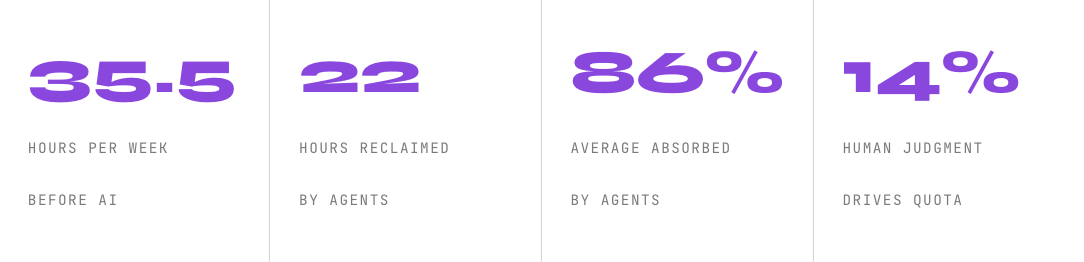
AI agents now absorb 83–87% of what an SDR does every week. Human judgment and relationships are what AI can't replace. Here's what the full week looks like — before and after — and two documents that show exactly how to build it.

Jomar Ebalida
March 09, 2026
All those AI note-taking apps are barnacles.
Not because they don't work — they do — but because they're solving for the wrong thing. Adding AI notetakers to a broken meeting structure doesn't fix the structure. It documents how broken it is, in very clean notes.
The same logic applies to every AI tool bolted onto the current SDR workflow. Take a rep whose week is 72% manual execution — list building, CRM logging, sequence management, enrichment, reporting — and hand them an AI writing assistant, and you haven't fixed anything structural. You've made one column in a broken spreadsheet slightly faster.
The problem isn't that SDRs need better tools. It's that the task architecture of the SDR role was never designed for a world where agents exist.
Before AI vs. After AI — every day
Here's what a standard SDR week looks like when every task, every day, is accounted for before AI is deployed with any structural intention:
Day | Focus | Before AI | After AI | Absorbed |
|---|---|---|---|---|
Monday | Prospecting | 7.9 hrs | ~39 min | 87% |
Tuesday | Follow-Up | 7.1 hrs | ~41 min | 87% |
Wednesday | Discovery Calls | 7.8 hrs | ~51 min | 85% |
Thursday | Outbound Surge | 7.3 hrs | ~46 min | 86% |
Friday | Review + Reset | 5.3 hrs | ~41 min | 85% |
Wednesday absorbs the least because it's the heaviest call day by design. The call itself — reading the room, pivoting when the conversation shifts, knowing the exact moment to ask for the meeting — is irreducibly human. No agent is in that room with the rep.
Everything else? Pre-call briefs compiled automatically 30 minutes before each discovery call. Transcripts captured in real time. CRM updated and follow-up drafted within two minutes of call end. The rep reviews, edits for tone, approves. That's the job now.
"AI made volume free. What's scarce is correctness — whether the thing you did was actually right for the customer, right for the deal, right for the relationship."
— From the Day in the Life Framework, Bowtie Funnel Consultancy
Why it changes everything about hiring
Agents absorb 72–86% of what an SDR does every week. The math is mapped task by task across every hour of the working day in the documents below. Research. Logging. Sequencing. Enrichment. Reporting. Real tasks — but none of them are why you hired an SDR.
You hired them for the 28%. The call. The read on a one-line reply. The instinct to pause a sequence on a prospect who scores 94 in the ICP model but feels wrong given what you heard last quarter. The judgment to recognize that "maybe next quarter" is a warm signal from someone who can't commit today but will in 60 days.
The AI slop tax is real. In a world where every rep is directing agents and their output is amplified across every touchpoint, a mediocre rep isn't just underperforming — they're generating a verification burden on the entire system. Low-judgment inputs, amplified by AI, create rework at machine speed.
This changes the hiring question fundamentally. Stop asking: can this person execute the current prospecting process? Start asking: can this person direct agents in a way that their instincts get amplified rather than diluted? Can they define a prospect's pain without being handed a call script? Do they default to action, or do they wait to be directed?
The results won't match your current performance review rubric. Your highest-rated reps — great at navigating the CRM, writing clean activity updates — may struggle. Those are coordination skills. Valuable in the old structure. Overhead in a strike team. Your most "frustrating" reps — the ones who skip process steps and occasionally book a meeting nobody expected — may be exactly who you need.
This is an intent problem, not a tools problem.
Klarna's AI agent handled 2.3 million customer conversations in its first month. Resolution times dropped from 11 minutes to two. The CEO projected $40 million in savings. And then customers started complaining — generic answers, robotic tone, no judgment on edge cases.
The agent was extraordinarily good at resolving tickets fast. That was the wrong goal to give it. Klarna's real intent wasn't "resolve tickets fast." It was "build lasting customer relationships that drive lifetime value." Same agent. Different intent. Completely different outcome.
The SDR parallel is direct. Deploy a Personalization Agent with the goal of "send more emails" and you get more emails. Deploy it with the intent of "reach the right person with the right angle at the right moment in their buying journey" and you get pipeline.
This is why agent setup is a leadership and ops responsibility — not the rep's burden. The rep's job is to use agents well and catch what they get wrong. That review layer is the job. It lives squarely in the 13–17% that drives quota.
Get both documents — free.
One for the rep. One for the builder.
|

|
You didn't get a cost reduction. You got a force multiplier.
Every conversation about AI and SDR teams frames it as a cost story. Hit the same quota with fewer reps. Same mission, fewer headcount, lower burn. It's a staggering failure of imagination.
Your SDRs didn't get cheaper. They got more powerful. A rep who learns to direct agents is operating at the output level of a much larger function. The question isn't: how many SDRs do I need to hit my current number? The question is: given that each rep now has the productive capacity of a full prospecting team, what pipeline were we previously unable to build?
The companies that get this right aren't cutting their teams to protect current margins. They're restructuring — smaller units, bigger territory — and going after pipeline that was impossible when manual execution consumed 70% of every working day.
You did not get a cost reduction. You got an army. The question is whether you have the strategic clarity to deploy it.
Two documents. One framework. Everything to build it.
The Day in the Life framework exists in two versions, designed for two audiences working on the same problem from different directions.
The Practitioner Edition is for SDRs, BDRs, sales leaders, and CROs. Every task of the SDR week mapped before and after AI — Monday through Friday. Every agent. Every judgment call that stays human. The 72/28 rule in full detail.
The Technical Edition is for RevOps, IT, and automation architects. Every agent skill mapped with its trigger signal, the tools it orchestrates, the context it needs, and the SKILL.md build instructions to deploy it on Claude. 22 skills. A complete build checklist.
Together, they answer both questions: what does the correctly architected SDR day look like — and how do you actually build it.